
Chronograph Dive Watch: Complete Guide
Two tool watches in one case — water-ready diving plus a working stopwatch. Here's how it all works.
Chronograph Dive Watch: Complete Guide
A watch can look powerful in photos, but the real question is simple: does it actually give you useful timing, real water confidence, and everyday wearability?
A chronograph dive watch combines two tool-watch ideas in one case. It has the water-ready design of a dive watch and the stopwatch function of a chronograph. That means you can track elapsed time with the rotating bezel and measure shorter timing intervals with the chronograph pushers and subdials.
Dive watches. Built with purpose.
In this guide, we'll explain what a chronograph dive watch is, how it works, how it compares with a regular dive watch, whether chronograph pushers can be used underwater, and what to check before buying one.
- What is a chronograph dive watch?
- Chronograph vs dive watch quick comparison
- How the chronograph works on a diver
- Can you use the pushers underwater?
- Movement types: meca-quartz, quartz, and automatic
- What to look for when buying a chronograph dive watch
- Our tested pick under $200
- FAQ
⏱What Is a Chronograph Dive Watch?
A chronograph dive watch is a dive watch with an added stopwatch function. A standard dive watch uses a rotating bezel to track elapsed minutes, while a chronograph adds pushers and subdials to time events more precisely.
It is made for buyers who want the strength and water-ready feel of a dive watch, but also want the practical timing function of a chronograph.
A chronograph dive watch usually includes:
-
A rotating dive bezel that helps track elapsed minutes. On a traditional dive watch, this is one of the main timing tools because it lets the wearer quickly compare the bezel marker with the minute hand.
-
Chronograph pushers that start, stop, and reset the stopwatch. These are usually placed above and below the crown, giving the watch a more technical and instrument-like appearance.
-
Subdials for timing information such as running seconds, elapsed chronograph minutes, and sometimes a 24-hour indicator. These subdials make the dial more functional, but they also make readability more important.
-
Strong water resistance that separates a true dive chronograph from a regular fashion chronograph. A watch can look sporty and still not be suitable for serious water use, so the rating and case design matter.
-
Luminous hands and markers that help the wearer read the time in low light. For any dive-style watch, lume is not just decoration; it is part of the tool-watch function.
-
A screw-down crown and secure case construction that help protect the movement from moisture. On a chronograph diver, pusher design is especially important because pushers are moving parts.
⚖️Chronograph vs Dive Watch Quick Comparison
A chronograph and a dive watch are not the same thing. A dive watch is mainly built for water resistance, legibility, and elapsed-time tracking. A chronograph is mainly built for stopwatch timing. A chronograph dive watch combines both, but the extra function usually adds more thickness, more dial detail, and more moving parts.
|
Feature |
Dive Watch |
Chronograph Watch |
Chronograph Dive Watch |
|
Main purpose |
Built for water use and elapsed-time tracking with a bezel. |
Built to measure timed events with pushers and subdials. |
Combines dive-watch water confidence with chronograph timing. |
|
Key feature |
Rotating bezel, readable dial, strong lume, secure crown. |
Stopwatch function, central chronograph hand, timing registers. |
Bezel, pushers, subdials, lume, and water-resistant case design. |
|
Best use |
Swimming, recreational water use, diving style, and daily durability. |
Sports timing, driving, workouts, cooking, or interval tracking. |
Buyers who want a bold tool watch with both water-ready design and stopwatch function. |
|
Main trade-off |
Less precise for seconds-level event timing. |
Often less focused on water use unless specifically built for it. |
Usually larger, thicker, and busier than a simple three-hand dive watch. |
|
Buyer fit |
Best for someone who wants clean readability and classic dive-watch function. |
Best for someone who mainly wants timing tools. |
Best for someone who wants a sportier, more technical dive watch. |
⚙️How the Chronograph Works on a Diver
A chronograph dive watch works like a standard chronograph, but it is built into a more water-resistant dive-style case. The chronograph is separate from the regular timekeeping function, so the main watch continues running even when the stopwatch is stopped or reset.
Most chronograph divers use two pushers on the side of the case:
-
The top pusher starts and stops the chronograph. When you press it once, the chronograph seconds hand begins moving. When you press it again, the hand stops so you can read the elapsed time.
-
The bottom pusher resets the chronograph. After the chronograph is stopped, pressing the lower pusher returns the timing hand and registers back to zero.
-
The central chronograph seconds hand tracks stopwatch seconds. This is different from the regular running seconds hand, which is often placed inside one of the subdials.
-
The subdials show extra timing information. Depending on the movement, they may show elapsed minutes, running seconds, or a 24-hour display.
▮ top + bottom pushers ▮ screw-down crown ▮ chrono seconds hand
Step-by-step use
Start
Press the top pusher. The central chronograph hand begins counting seconds.
Stop
Press the same top pusher again. The chronograph stops and shows elapsed time.
Read
Use the subdials to check elapsed minutes or other timing information.
Reset
Press the lower pusher only after stopping. The hand returns to zero cleanly.
Step 1: Start the timing
Press the top pusher. The central chronograph hand begins counting seconds.
Step 2: Stop the timing
Press the same top pusher again. The chronograph stops and shows the elapsed time.
Step 3: Read the subdials
Use the subdials to check elapsed minutes or other timing information. This is where chronographs give more detail than a bezel alone.
Step 4: Reset the chronograph
Press the lower pusher only after stopping the chronograph. The hand should return to zero cleanly.
Subdials explained
Chronograph subdials can look complicated, but each one has a job:
-
Running seconds subdial: shows that the regular watch movement is running.
-
Chronograph minute subdial: shows how many minutes the stopwatch has measured.
-
24-hour subdial: shows time in 24-hour format on many meca-quartz chronographs.
-
Elapsed hour register: appears on some chronographs for longer timing sessions.
A chronograph is also different from a tachymeter. The chronograph is the stopwatch mechanism. How to use a tachymeter on a dive watch is necessary to calculate speed over a known distance.
🌊Can You Use the Pushers Underwater?
The honest answer is: only if the watch is specifically designed for it. This is one of the most important buyer questions because chronograph pushers are moving parts, and moving parts create more sealing challenges than a simple three-hand dive watch.
A high water-resistance rating does not automatically mean every button should be pressed underwater. The pusher system must be designed and sealed for that purpose.
Why underwater pusher use is risky
-
Pushers move through the case wall. Every moving opening needs gaskets or seals. If the pusher is pressed under pressure and the design is not made for that, water can enter the case.
-
Screw-down pushers reduce risk. When pushers screw into the case, they help lock the system and protect against accidental operation.
-
ISO-style dive-watch testing is more demanding than ordinary water-resistance claims. Dive watches are tested beyond their rated pressure, including tests at 125% of the stated rating and checks involving crowns or pusher buttons where applicable.
-
Real-world use is different from a product page claim. Salt water, age, worn seals, temperature changes, and impact can affect water resistance over time, so regular pressure testing matters.
Safe buyer rule
Before using a chronograph dive watch around water, check:
-
Water-resistance rating: A serious dive-style watch should clearly state the depth rating, such as 200M, 300M, or 500M.
-
Crown design: A screw-down crown is preferred because it helps protect the movement from water entry.
-
Pusher design: Screw-down or locking pushers are important on a chronograph diver because the pushers are the most sensitive part of the design.
-
Brand instructions: Do not assume the pushers can be used underwater unless the product guidance clearly says so.
-
Service history: Even a strong dive watch can lose water resistance if seals age or the case has been opened.
For the AbyssForce 500M
The AbyssForce 500M Meca-Quartz Dive Chronograph is built with 500M / 50 BAR water resistance, a screw-down crown, and two screw-down chronograph pushers. It also uses a solid 316L stainless steel case and a rotating dive bezel.
That gives it stronger water-use credibility than a basic fashion chronograph. Still, our practical recommendation is conservative:
Set the watch before water use, make sure the crown and pushers are fully secured, and avoid unnecessary pusher use underwater unless the watch's instructions clearly allow it.
🔋Movement Types: Meca-Quartz, Quartz, and Automatic
Chronograph dive watches usually come with one of three movement types: meca-quartz, quartz, or automatic mechanical chronograph. The movement affects price, accuracy, servicing, thickness, and the feel of the chronograph reset.
|
Movement Type |
How It Works |
Main Benefit |
Trade-Off |
Best For |
|
Meca-quartz |
Uses quartz timekeeping with a mechanical-style chronograph module. |
Gives quartz accuracy with a more satisfying chronograph feel. |
Still battery-powered, so it is not a fully mechanical watch. |
Buyers who want value, accuracy, and crisp chrono action. |
|
Quartz |
Uses battery-powered timekeeping and electronic chronograph timing. |
Reliable, accurate, affordable, and low maintenance. |
The chronograph feel may be less mechanical or premium. |
Practical daily users who want easy ownership. |
|
Automatic chronograph |
Uses a fully mechanical movement powered by wrist motion or winding. |
Offers traditional mechanical watchmaking appeal. |
Usually thicker, more expensive, and more costly to service. |
Enthusiasts who value mechanical complexity. |
Accuracy and crisp reset without automatic-chronograph cost or thickness.
Why meca-quartz works well in a dive chronograph
A meca-quartz dive chronograph is a practical middle ground because it gives the wearer quartz accuracy with a chronograph action that feels closer to mechanical. This matters for affordable dive chronographs because fully mechanical automatic chronographs often cost much more and can make the case thicker.
For many buyers, meca-quartz is the smarter daily-wear choice because:
-
It keeps accurate time with less maintenance. Quartz timekeeping is usually more accurate month-to-month than most mechanical watches.
-
It gives a sharper chronograph reset. Many meca-quartz chronographs have a snap-back reset that feels more satisfying than a basic quartz stopwatch.
-
It helps control the price. A meca-quartz chronograph can deliver real timing function without the cost of a full mechanical chronograph movement.
-
It fits practical buyer expectations. If you want the look, timing function, and feel of a chronograph without luxury servicing costs, meca-quartz makes sense.
Why AbyssForce uses meca-quartz
The AbyssForce 500M uses the Seiko VK63 meca-quartz movement. It is battery-powered quartz timekeeping with a mechanical chronograph module, ±20 seconds per month accuracy, and approximately 3-year battery life.
That makes it a practical match for this watch because the AbyssForce is built for buyers who want a bold dive chronograph with reliable everyday timing, and offers Quartz vs Automatic Watches: Which Is Better for You?
🛒What to Look for When Buying a Chronograph Dive Watch
Buying a chronograph dive watch is not just about choosing the most complicated dial. A good one should be water-ready, readable, comfortable, honestly specified, and supported by a seller that clearly explains what the watch is.
Use this buyer checklist before choosing one.
1. Real Water Resistance
Water resistance should be clearly stated, not hidden behind vague language. For dive-style use, look for ratings such as 200M, 300M, or 500M.
-
200M and 300M ratings are common for modern dive watches. These are strong ratings for serious recreational water use when the watch is properly built and maintained.
-
500M gives extra margin but often adds size and weight. A higher rating usually requires stronger case construction, thicker components, and better sealing.
-
Do not rely on the word waterproof. Watches are better described as water-resistant because seals can age and water resistance can change over time.
2. Screw-Down Crown and Pushers
A chronograph dive watch has more openings than a simple diver, so the crown and pushers matter.
-
A screw-down crown helps protect the movement. It locks the crown into the case and reduces the risk of accidental opening.
-
Screw-down pushers are especially important. Chronograph pushers are functional controls, and on a dive chronograph, they need better sealing than regular fashion-watch pushers.
-
Unlocked pushers can be a weak point. If the product does not clearly explain the pusher design, be careful with water use.
3. Clear Dial and Strong Lume
Chronographs naturally look busier than three-hand dive watches. That means legibility matters even more.
-
The main hands should be easy to identify. If the subdials overpower the hour and minute hands, the watch becomes harder to read.
-
Lume should be visible on the hands and markers. Low-light readability is one of the main reasons buyers choose dive watches.
-
Subdials should support the design, not confuse it. A useful chronograph layout should make timing easier, not turn the dial into a cluttered dashboard.
4. Case Size and Weight
Chronograph dive watches are often larger because the movement, case sealing, pushers, and bezel require more space.
-
Check the case diameter. A 40–43mm watch wears very differently from a 48mm watch.
-
Check the thickness. Thicker dive chronographs can feel more substantial but may not fit easily under cuffs.
-
Check the weight. A heavy steel watch can feel premium and rugged, but it may not suit buyers who prefer lighter daily wear.
-
Match the watch to your wrist size. The AbyssForce 500M is best suited for buyers who like bold wrist presence and larger case dimensions.
For more information, read about Dive Watch Size Guide
5. Movement Choice
The movement should match your ownership style.
-
Choose meca-quartz if you want value and accuracy. This is ideal for buyers who want a chronograph feel without automatic chronograph pricing.
-
Choose quartz if you want simple ownership. Quartz is practical, easy to maintain, and accurate for daily use.
-
Choose an automatic chronograph if you value mechanical complexity. This is more appealing to collectors, but it usually brings higher cost and servicing needs.
🏅Our Tested Pick Under $200
AbyssForce 500M Meca-Quartz Dive Chronograph
The AbyssForce 500M Meca-Quartz Dive Chronograph is our tested pick for buyers who want a bold, affordable dive chronograph with serious wrist presence.
It is not trying to be a slim dress watch. It is built as a substantial steel tool watch with a technical dial, screw-down pushers, and a 500M / 50 BAR rating.
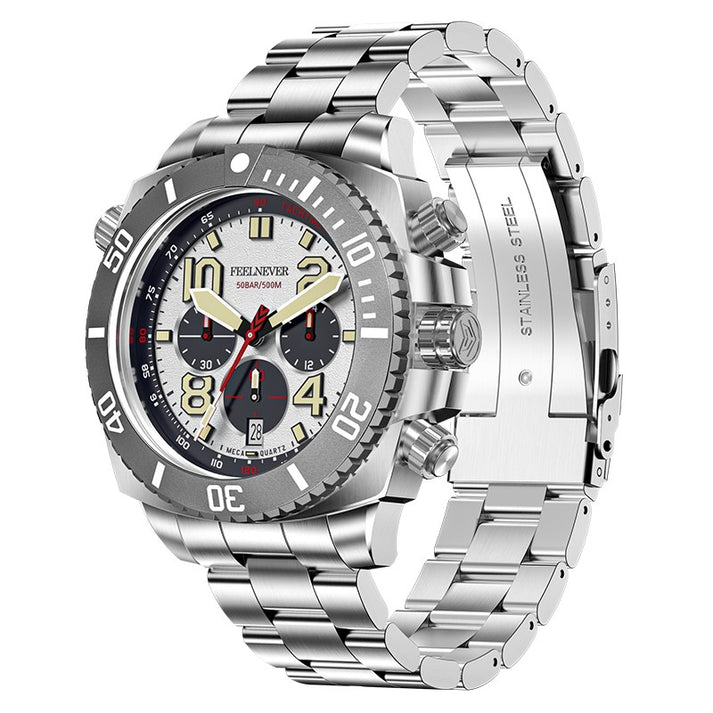
AbyssForce 500M Key Specs
|
Feature |
Specification |
|
Watch type |
Meca-quartz dive chronograph |
|
Movement |
Seiko VK63 meca-quartz |
|
Accuracy |
±20 seconds per month |
|
Battery |
CR1216, approximately 3 years |
|
Water resistance |
500M / 50 BAR |
|
Case material |
Solid 316L stainless steel |
|
Bracelet material |
Solid 316L stainless steel |
|
Crystal |
Anti-reflective sapphire |
|
Crown |
Screw-down crown |
|
Pushers |
Two screw-down chronograph pushers |
|
Bezel |
Rotating dive bezel |
|
Subdials |
60-minute, 24-hour, and running seconds |
|
Date |
6 o'clock position |
|
Lume |
Luminous hands and markers |
|
Case diameter |
48mm |
|
Case thickness |
14mm |
|
Lug width |
24mm |
|
Bracelet length |
230mm |
|
Weight |
270g |
|
Best wrist size |
7.0 inches and larger |
|
Warranty |
12 months |
|
Returns |
30-day easy returns |
Our Wear Note:
After wearing the AbyssForce 500M, the first thing you notice is the case presence. At 48mm wide and 270g, it feels like a serious steel watch, not a lightweight fashion chronograph.
-
The 14mm thickness keeps it substantial without making it feel extreme for a 500M-rated chronograph. The screw-down crown and pushers give the case a more purpose-built feel, while the Seiko VK63 movement keeps the watch practical for everyday timing.
What We Like
✓ What we like
- 500M / 50 BAR — strong water confidence
- Seiko VK63 meca-quartz · ±20 s/mo · ~3-yr battery
- Screw-down pushers boost dive credibility
- Anti-reflective sapphire crystal
- Full 316L steel build, strong wrist presence
! What buyers should know
- 48mm case is large — not for 40–42mm fans
- 270g weight is noticeable
- Busier dial than a simple diver
- Not a fully automatic mechanical chronograph
- Transparent about current dial branding
-
500M / 50 BAR water resistance gives strong confidence around water. For most recreational users, this is more than they will ever practically need, but it supports the watch's serious dive-chronograph positioning.
-
The Seiko VK63 meca-quartz movement is practical. It gives ±20 seconds per month accuracy, approximately 3-year battery life, and a more mechanical-feeling chronograph reset than a basic quartz chrono.
-
The screw-down pushers improve the dive-watch credibility. Many chronographs are not built for serious water use, so screw-down chronograph controls are an important feature.
-
The anti-reflective sapphire crystal adds real daily value. Sapphire is highly scratch-resistant, and the anti-reflective coating helps keep the dial easier to read in bright light.
-
The full steel build gives the watch a strong wrist presence. The 316L stainless steel case and bracelet make the watch feel substantial, which suits buyers who prefer bold tool watches.
What Buyers Should Know
-
The 48mm case is large. This is not ideal for buyers who prefer 40mm or 42mm dive watches.
-
The 270g weight is noticeable. Some buyers will love the heavy steel feel, while others may prefer a lighter titanium or slimmer daily watch.
-
The dial is busier than a simple diver. The subdials, tachymeter scale, and chronograph hand give it a technical look, but minimalist buyers may prefer a cleaner layout.
-
It is not a fully automatic mechanical chronograph. The AbyssForce uses a meca-quartz movement, which is battery-powered for timekeeping and mechanical-style for the chronograph action.
-
The brand is transparent about dial branding. Current inventory may feature manufacturer branding while Future Wrist Tech transitions toward custom-branded production.
Prefer something lighter or slimmer instead? Compare the titanium TitanPro 300M for everyday comfort, or the automatic AbyssPro 1000M if you want maximum depth rating without a chronograph.
Shop the AbyssForce 500MFAQ
A chronograph dive watch can be highly water-resistant, but waterproof is not the best word because seals can age and water resistance depends on construction and maintenance.
For a proper dive-style chronograph, check:
- the stated water-resistance rating
- screw-down crown
- screw-down or protected pushers
- case construction
- brand guidance for water use
- service history and seal condition
Yes, but only if it is a real dive chronograph, not just a sporty-looking watch. A regular chronograph may not have the sealing, crown design, bezel, or lume needed for serious water use.
Before diving or using it heavily around water, confirm:
- whether the watch is rated for dive use
- whether the crown is fully secured
- whether the pushers are screw-down or specially sealed
- whether the seals have been pressure-tested recently
Only if the watch is specifically designed for that. Many chronographs should not have their pushers pressed underwater because operating a pusher can affect the seal.
The safer rule is:
- set the watch before water use
- screw down the crown
- screw down the pushers
- avoid pressing buttons underwater unless the brand clearly allows it
Dive chronographs are worth it if you want one watch that combines water-ready construction with stopwatch timing.
They are especially useful for buyers who want:
- a sportier tool-watch look
- practical stopwatch timing
- stronger wrist presence
- dive-watch design
- everyday durability
They may not be ideal if you prefer slim, simple, minimalist watches.
Yes. Meca-quartz is a strong choice for an affordable dive chronograph because it combines quartz accuracy with a more mechanical-feeling chronograph action.
It is a practical choice for buyers who want:
- accurate daily timekeeping
- lower ownership cost
- crisp chronograph reset
- less servicing concern than a full mechanical chronograph
- strong value in an affordable tool watch
A meca-quartz chronograph can last many years with normal care, battery changes, and seal maintenance. In the AbyssForce 500M, the stated battery is a CR1216 with approximately 3 years of battery life under normal use.
The best affordable dive chronograph should have clear water resistance, screw-down crown, secure pushers, readable lume, a reliable movement, and honest specs.
For buyers who want a bold 500M meca-quartz option under $200, the AbyssForce 500M is a strong tested pick from Future Wrist Tech.
🔗 Reference this guide
Watch and gear writers are welcome to cite this guide. Copy the ready-made citation below.
Loading citation…